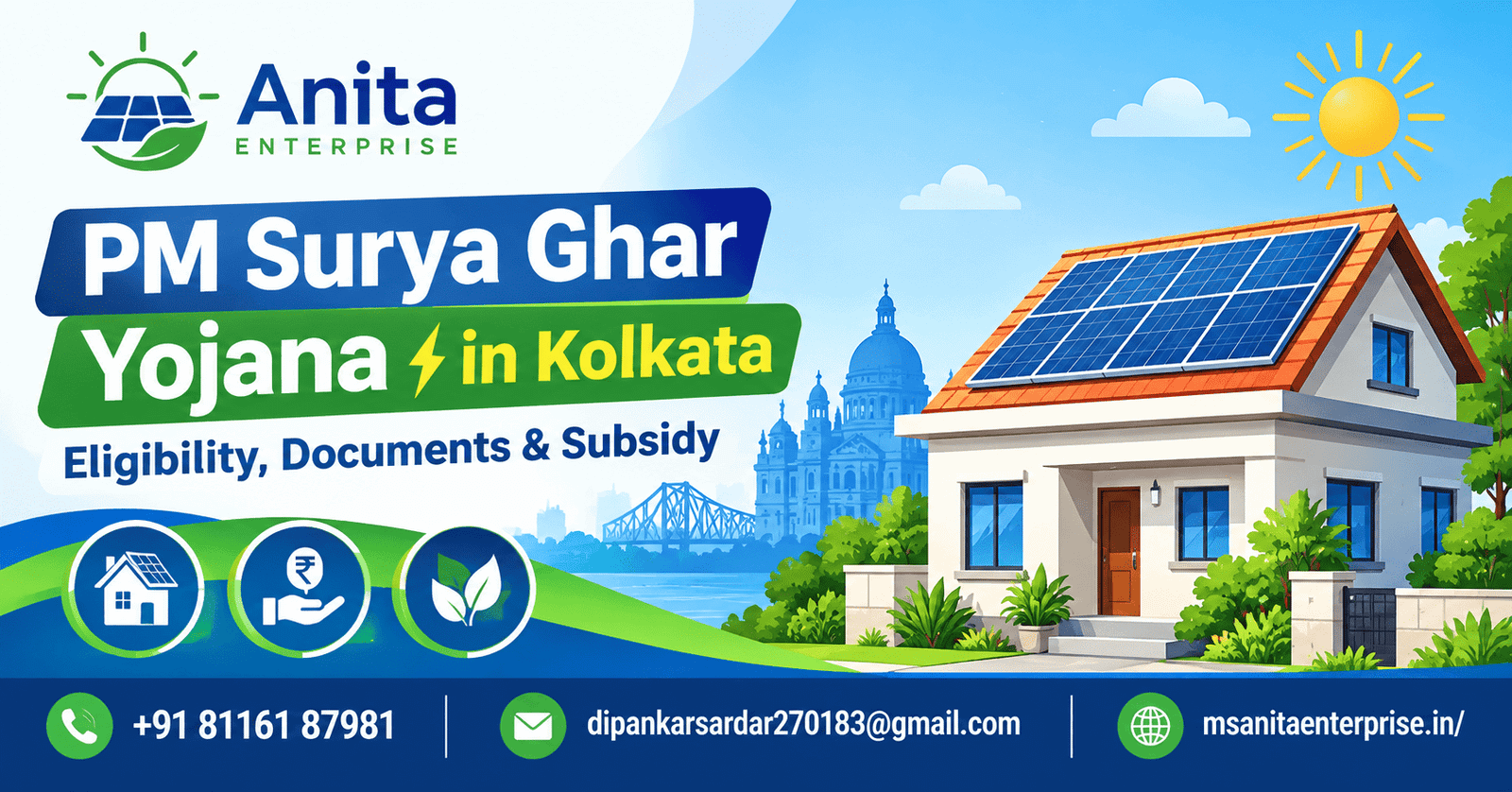
If your electricity bill in Kolkata has been climbing every summer, you’re not imagining it. Between rising CESC tariffs and longer AC hours, a lot of households here are now looking seriously at rooftop solar — and the PM Surya Ghar Yojana is what’s making that switch financially realistic. This guide walks through who qualifies, what papers you’ll need, how much subsidy you can actually expect, and what’s changed recently for West Bengal residents specifically.
What Is PM Surya Ghar Yojana?
Launched by the central government in February 2024, PM Surya Ghar Muft Bijli Yojana is a rooftop solar subsidy scheme meant to bring free or heavily discounted electricity to a crore households nationwide. It’s run through the Ministry of New and Renewable Energy, and the subsidy is paid directly into your bank account — no middlemen skimming it off your installation bill.
Why This Matters More in Kolkata Right Now
For a while, West Bengal lagged badly on this scheme. The sticking point was net metering — without clear DISCOM rules for it, subsidies simply couldn’t be released, and only a few hundred households in the entire state had benefited by late 2024. That’s changed. With the state’s net metering framework now in place and the scheme formally rolled out here, applications from CESC and WBSEDCL consumers are moving again. If you tried applying earlier and hit a wall, it’s worth trying again.
Subsidy Amount: How Much Can You Get?
This is the part everyone wants to know first, so here’s the straight answer:
- 1 kW system: ₹30,000
- 2 kW system: ₹60,000
- 3 kW and above: ₹78,000 (this is the maximum — it doesn’t increase beyond 3 kW)
The math is ₹30,000 per kW for the first 2 kW, then ₹18,000 for the third. Most Kolkata flats and independent houses with monthly bills in the ₹2,000–₹4,000 range find a 2–3 kW system fits well.
How Subsidy Is Calculated
It’s based on the government’s benchmark cost for your system size, not what your vendor actually charges. If your installer’s rate comes in below that benchmark, you still get the full subsidy amount — which can bring your net cost down further.
Eligibility Criteria
Who Can Apply
- You’re an Indian citizen and own the residential property
- You have an active electricity connection, and the meter is in your name (or your spouse’s)
- Your home doesn’t already have a solar system on the same connection
- There’s no income cap — this isn’t restricted to lower-income households
A Few Things to Check Locally
Rented flats generally aren’t eligible — ownership matters. And in Kolkata, most areas fall under CESC rather than WBSEDCL, so confirm which discom services your address before applying, since the portal will ask.
Documents Required
Keep these ready before you start:
- Aadhaar card
- Latest electricity bill
- Property ownership proof (sale deed, tax receipt, or similar)
- Bank passbook or a cancelled cheque
- A passport-size photograph
One tip that saves real headaches: make sure your name matches exactly — spelling included — across your bill, Aadhaar, and bank account. Name mismatches are the single biggest reason applications stall.
How to Apply: Step by Step
- Register on pmsuryaghar.gov.in with your state, discom, and consumer number
- Apply for rooftop solar and pick a system size based on your monthly usage
- Wait for your discom’s feasibility approval
- Choose an empanelled vendor and get the system installed
- Apply for your net meter once installation is done
- Submit the commissioning report after discom inspection
- Add your bank details — subsidy typically lands within 30 days
Total timeline from start to subsidy in hand usually runs 45–90 days.
Frequently Asked Questions
Is there a subsidy limit for larger systems?
Yes — ₹78,000 is the ceiling regardless of whether you install a 5 kW or 10 kW system.
Can tenants in Kolkata apply?
Generally no. The scheme requires you to own the property.
Does CESC support net metering under this scheme?
Yes, following West Bengal’s updated net metering regulations, CESC and WBSEDCL consumers can now apply through the national portal.
How long does subsidy disbursement take after installation?
Usually within 30 days of your commissioning report being verified, though it can stretch further during high-demand periods.
Are there additional state subsidies in West Bengal?
Currently, West Bengal offers the central subsidy without a separate state top-up, unlike a few other states — check the portal periodically as this can change.
Ready to Go Solar?
Rooftop solar in Kolkata isn’t just an eco-friendly move anymore — with this subsidy, it’s a genuinely practical way to cut your monthly bills for the next 25 years. At Anita Enterprise, we help Kolkata homeowners through the entire process — from checking your eligibility and paperwork to installation and net metering — so you don’t have to figure out the portal alone. Reach out to us for a free consultation and site assessment.